When comparing Oak vs Acacia hardwood flooring, the key differences include hardness rating, grain appearance, and overall durability. Solid Oak hardwood flooring typically measures between 1290 and 1360 on the Janka hardness scale, while Acacia hardwood flooring generally ranges between 1700 and 2200. This means Acacia offers stronger dent resistance, while Oak provides a more uniform and traditional grain structure. Both are commonly milled in standard 3/4 inch solid hardwood flooring thickness, supporting multiple refinishing cycles and long-term residential performance.
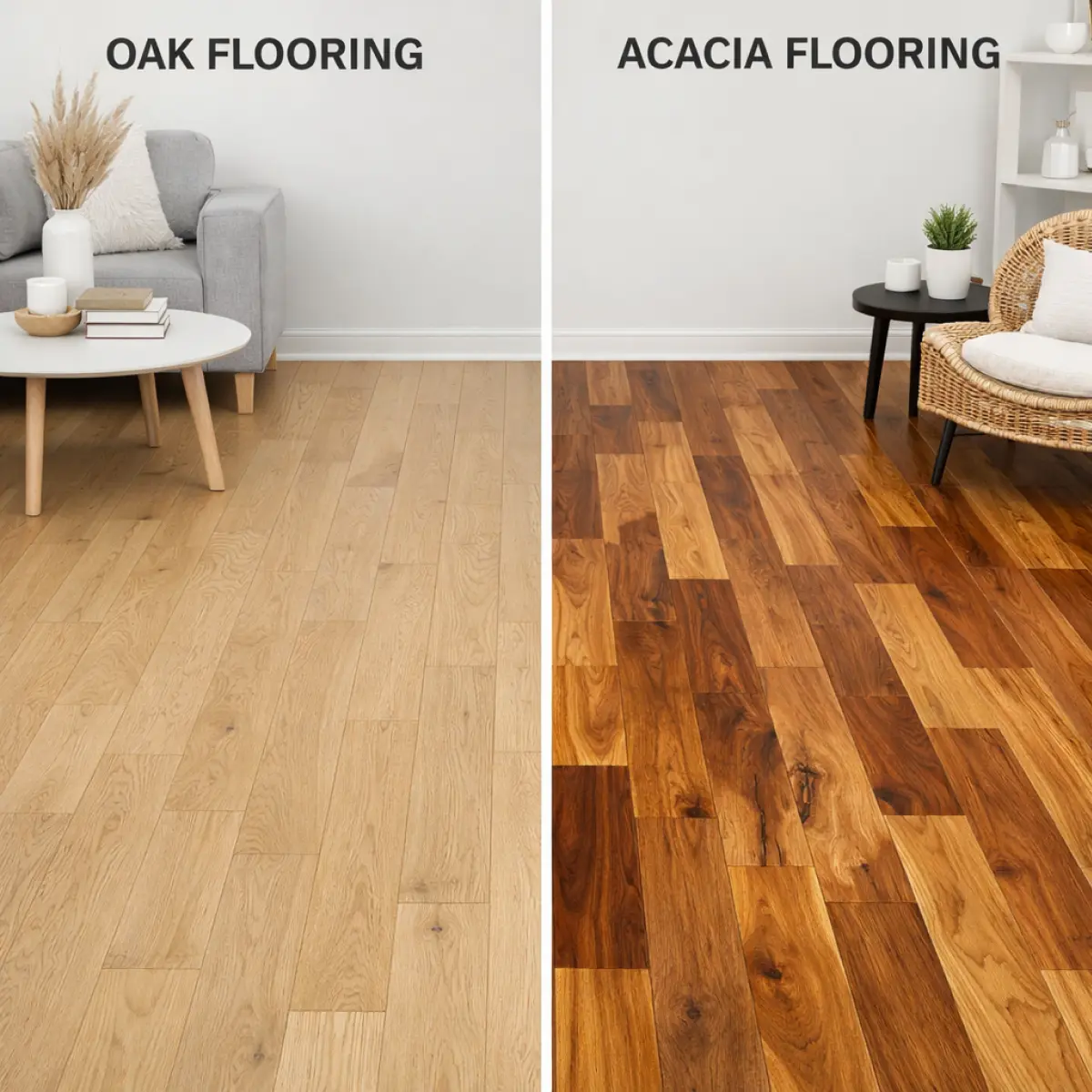
Oak hardwood flooring:
Acacia hardwood flooring:
For full hardness explanation, review the Janka Hardness Scale Guide.
See Solid Oak Hardwood Flooring and Acacia Hardwood Flooring Guide for detailed species visuals.
Acacia’s higher hardness rating makes it well-suited for active households. Oak remains durable for most residential environments when properly maintained. For additional durability comparison, see Best Hardwood Flooring for High Traffic Areas.
Both Oak and Acacia are available in wide plank solid hardwood flooring formats. Acacia’s dramatic grain becomes more pronounced in wider boards. Oak provides a cleaner, more uniform look in wide plank installations. See Wide Plank Solid Hardwood Flooring for width considerations.
Oak hardwood flooring generally falls within moderate pricing ranges. Acacia hardwood flooring may reflect slightly higher material cost due to density and sourcing.
Final project pricing depends on:
See Hardwood Flooring Cost Per Square Foot for detailed breakdown.
Both Oak and Acacia are commonly milled in 3/4 inch solid hardwood flooring thickness.
This allows:
See 3/4 Inch Solid Hardwood Flooring for thickness details.
Comparing species in your own lighting environment is recommended before final purchase. Order Hardwood Samples to review both Oak and Acacia side by side.