When comparing Jatoba vs Cumaru hardwood flooring, the key differences include hardness rating, color tone, and overall density. Brazilian Cherry (Jatoba) hardwood flooring measures approximately 2350 on the Janka hardness scale, while Brazilian Teak (Cumaru) hardwood flooring measures approximately 3540. Both are significantly harder than Red Oak hardwood flooring and White Oak hardwood flooring, but Cumaru offers superior dent resistance due to its higher density. Jatoba is often chosen for its deep reddish tone, while Cumaru is selected for its golden-brown color and extreme durability.
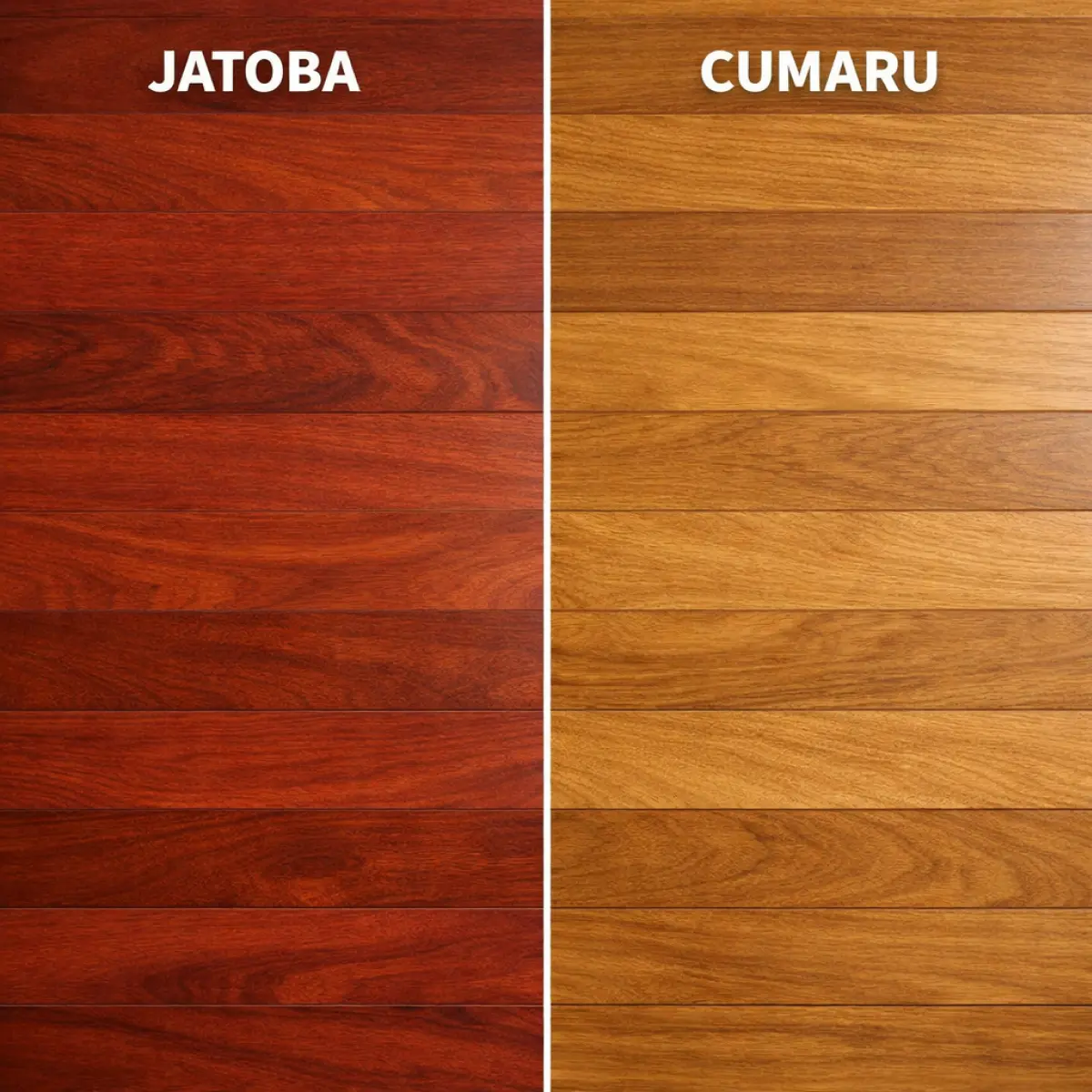
Brazilian Cherry (Jatoba):
Brazilian Teak (Cumaru):
For full hardness explanation, review the Janka Hardness Scale Guide.
See Brazilian Cherry (Jatoba) Hardwood Flooring Guide and Brazilian Teak (Cumaru) Hardwood Flooring Guide for full species breakdown.
Both species offer excellent residential durability.
For high traffic evaluation, review Best Hardwood Flooring for High Traffic Areas.
Both Jatoba and Cumaru are commonly milled in 3/4 inch solid hardwood flooring thickness. Due to Cumaru’s extreme density, professional-grade tools are recommended for installation. See 3/4 Inch Solid Hardwood Flooring for structural guidance.
Both species perform well in wide plank solid hardwood flooring formats. Jatoba emphasizes red grain depth in wider boards. Cumaru highlights golden-brown tonal richness. See Wide Plank Solid Hardwood Flooring for width considerations.
Both are premium tropical hardwood species. Cumaru may reflect slightly higher material pricing due to density.
Total cost depends on:
See Hardwood Flooring Cost Per Square Foot for full pricing breakdown.
Comparing both species in your lighting environment is recommended before committing to full square footage. Order Hardwood Samples to review Brazilian Cherry and Brazilian Teak side by side.